PandaPower vs OpenDSS Load Flow Results: Understanding the Differences
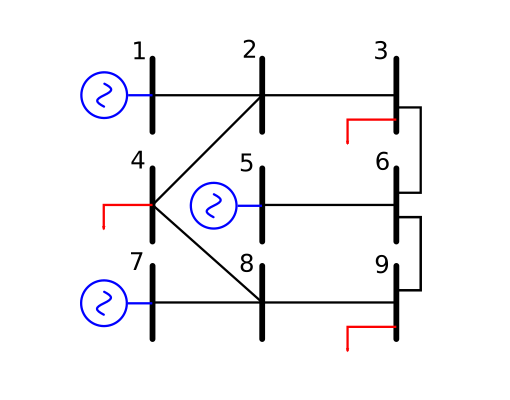
Electrisim supports both pandapower and OpenDSS as power flow engines. When comparing load flow results between these two tools on the same network, you may observe noticeable differences in voltage magnitude, voltage angles, and reactive power. This article summarizes the root causes and how to align results when needed.
Root Cause: Different External Grid Models
The main source of discrepancy lies in how each tool models the external grid (slack bus):
| Tool | External Grid Model |
|---|---|
| PandaPower | Ideal voltage source with zero impedance for power flow. The short-circuit MVA (s_sc_max_mva) is used only for short-circuit calculations, not for load flow. |
| OpenDSS | Voltage source behind impedance (Thevenin equivalent). The mvasc3 parameter always creates a source impedance: Zsc = V² / mvasc3. This impedance affects both power flow and fault studies. |
Observed Differences
When running the same network (e.g. two buses, 20 km line, static generator) with a typical short-circuit MVA of 1000 MVA at 400 kV:
- Voltage magnitude: PandaPower maintains 1.0 p.u. at the slack bus; OpenDSS may show ~1.17 p.u. due to capacitive charging current through the source impedance (Ferranti effect).
- Reactive power: External grid Q can differ significantly (e.g. -148 Mvar vs -201 Mvar) because the source impedance in OpenDSS absorbs or generates additional reactive power.
- Voltage angles: Small phase shifts occur in OpenDSS due to the source impedance.
Why This Happens
At high voltage levels (e.g. 400 kV), transmission lines have substantial capacitance (e.g. 144 nF/km). Over 20 km, this creates ~145–200 Mvar of capacitive charging reactive power. In OpenDSS:
- This capacitive current flows through the source impedance (Zsc = 400²/1000 ≈ 160 Ω).
- The resulting voltage rise can be on the order of 14–17%.
- PandaPower, with an ideal slack bus, does not model this effect in the power flow.
Solution: Use a High Short-Circuit MVA in OpenDSS
To make OpenDSS behave more like PandaPower's ideal slack bus (for load flow comparison or when you want a "stiff" grid), use a high value for the short-circuit apparent power:
Set
s_sc_max_mvato 1,000,000 MVA (or higher) for the external grid. This reduces the source impedance to negligible levels (Zsc ≈ 0.16 Ω at 400 kV), so voltage and reactive power results align closely with PandaPower.
For short-circuit studies, you may still use a more realistic value (e.g. 1000–10000 MVA) to represent the actual grid strength.
Summary
- PandaPower: external grid = ideal slack bus (zero impedance) for power flow
- OpenDSS: external grid = Thevenin equivalent with finite impedance from mvasc3
-
Use
s_sc_max_mva = 1000000in OpenDSS when comparing load flow results or modeling a very stiff grid
References
- pandapower External Grid Documentation
- OpenDSS Vsource Documentation
- pandapower Power Flow
- OpenDSS Power Flow
Try our open-source (no installation needed) cloud software for load flow studies – app.electrisim.com. You can switch between pandapower and OpenDSS and compare results directly in your browser.