Open-Source Power Systems Analysis: Electrisim Validated Against Commercial Software
A comprehensive master's thesis from the Engineering Department of University of Palermo has demonstrated that Electrisim, an open-source load flow calculation software, achieves results comparable to commercial tools like Neplan.
Key Findings
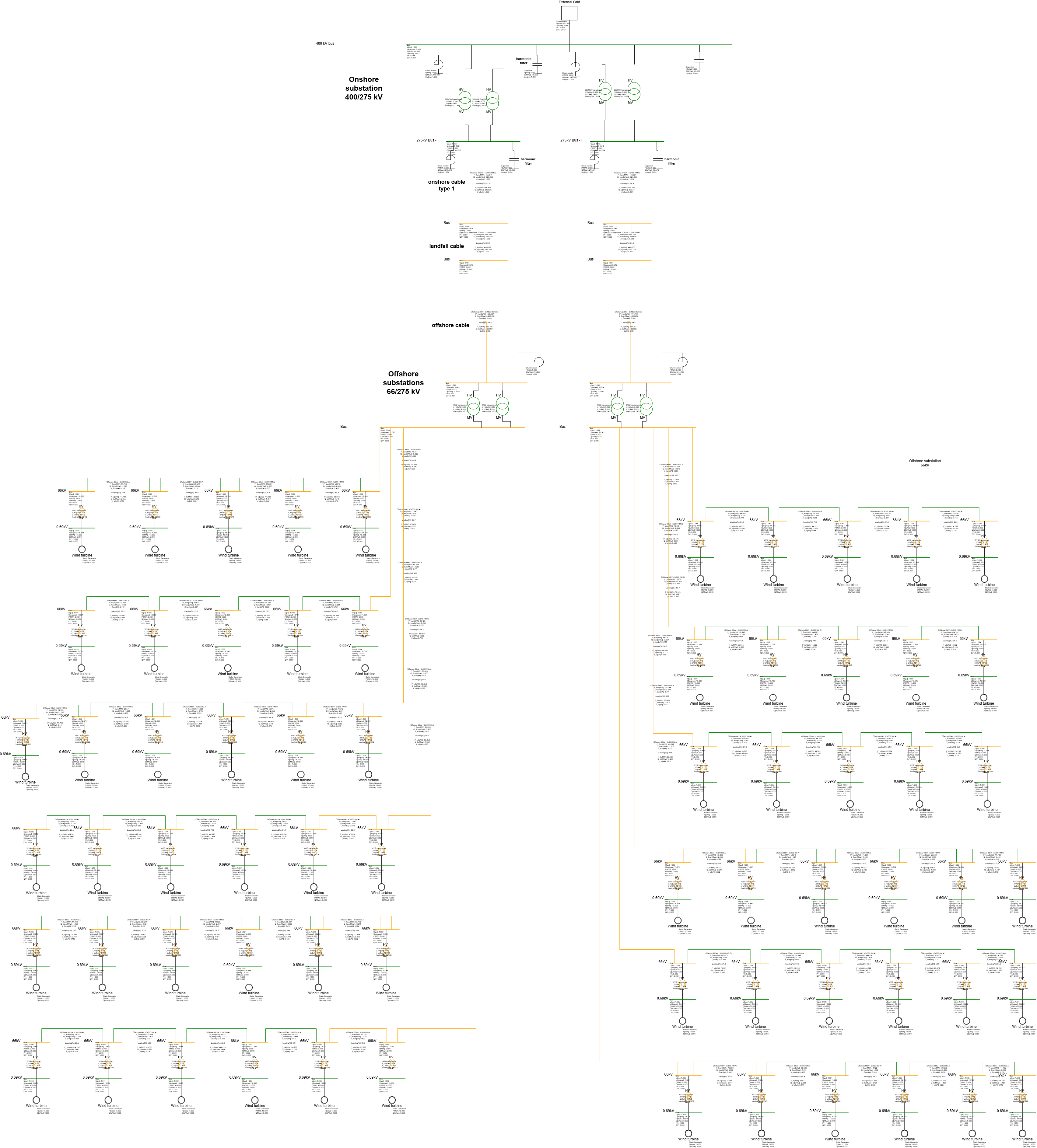
Biagio Messina's detailed research, titled "Analysis and Validation of an Open Source Software for Load Flow Calculations: Application to Test Networks and an Offshore Wind Farm Network", systematically compared Electrisim with Neplan across multiple IEEE test networks (4, 5, 6, and 14-node systems) and a real-world 1 GW offshore wind farm model.
The Results Speak for Themselves
- Small networks showed deviations below 1 kW/kVAr with percentage errors under 0.1%
- The 14-node IEEE network maintained mean errors below 2% with near-perfect correlation
- Statistical validation using MAE, RMSE, MAPE, and Pearson correlation confirmed exceptional consistency
- Real offshore wind farm simulations, including fault scenarios, demonstrated reliable performance
The study also included analysis of abnormal operating conditions (transformer shutdown scenarios), further validating Electrisim's robustness under challenging circumstances.
Methodology
The primary objective of this thesis was to validate the Electrisim software through a systematic comparison with the commercial program Neplan, recognized as one of the reference tools for analyzing power flows in electrical systems. The activity was conducted through a series of load flow simulations on standard IEEE test networks (4, 5, 6, and 14 nodes), characterized by increasing complexity, with the aim of progressively evaluating the consistency, stability, and reliability of the calculation engine.
This approach allowed for methodical verification of the open-source software's ability to accurately reproduce the results obtained with a consolidated commercial environment, while maintaining a stable calculation structure even as the network's complexity increased.
To quantitatively evaluate the differences between the two calculation environments, a statistical methodology was adopted based on consolidated accuracy indices, such as the Mean Absolute Error (MAE), the Root Mean Square Error (RMSE), and the Mean Absolute Percentage Error (MAPE), combined with the Pearson correlation coefficient. These parameters made it possible to objectively quantify the discrepancies and evaluate the linearity of the relationship between the calculated quantities.
IEEE Test Network Validation
The simulations conducted on the IEEE networks showed an almost perfect correspondence between the results obtained from the two software programs. For small-scale networks (4, 5, and 6 nodes), the absolute mean deviations remained below 1 kW or 1 kVAr, with percentage errors generally below 0.1%. Even for the 14-node IEEE network, despite its greater complexity, the deviations proved to be limited, with mean errors below 2% and correlation coefficients close to unity.
Offshore Wind Farm Case Study
A further investigation was carried out through the implementation of a real offshore wind farm network, in which not only was a power flow study conducted under normal conditions, but also an analysis of a fault scenario involving the shutdown of one of the transformers at the 66/150 kV substation. This case study, of particular technical interest, was simulated in both environments, with the objective of analyzing the system response and the behavior of the two calculation engines under abnormal conditions.
The comparison of results confirmed the overall good consistency between the two software programs, while highlighting some differences in the evaluation of reactive power. In particular, it was observed that up to short-circuit voltage (Vcc%) values of approximately 14–15%, the results were nearly identical. However, for higher values, such as 18%, it was noted that an increasing deviation in the calculated reactive power, attributable to the different sensitivity of the implemented transformer models.
The freely available 1 GW offshore wind farm model used in the study can be accessed here: https://electrisim.com/model-offshorewind
Collaboration and Improvements
During the modeling and simulation phases, constant contact was maintained with the Electrisim development team, with whom it was possible to analyze some critical issues related to the management of network parameters and encourage improvements to the calculation engine. Thanks to this collaboration, updates were introduced that made the software more stable and equipped with internal diagnostic functionalities for the automatic identification of modeling errors.
Why This Matters
Open-source tools like Electrisim offer transparency, accessibility, and customization possibilities that are particularly valuable for academia, research institutions, and engineering professionals. While commercial software maintains advantages in certain areas like dynamic analysis, this validation confirms that Electrisim provides a reliable, cost-effective alternative for load flow calculations.
Overall, the results obtained demonstrate that Electrisim represents a reliable and versatile solution for power flow analysis, positioning itself as a valid alternative to commercial software. Its open-source nature constitutes an added value in terms of transparency, accessibility, and customization possibilities, making it particularly suitable for use in academia, research, and small professional organizations.
However, it should be emphasized that commercial tools such as Neplan offer a higher level of completeness and robustness, particularly regarding dynamic analyses, which are currently not present in Electrisim. This difference does not represent a limitation, but rather a natural consequence of the different degree of maturity and the different scope of application of the two simulation environments.
Scalability and Future Developments
The work carried out confirmed that increasing system complexity does not significantly compromise model stability, demonstrating the scalability and robustness of the numerical approach adopted. Looking ahead, the integration of additional functionalities such as loss calculation, dynamic analysis, and detailed visualization of currently unavailable parameters, such as RMS current values, phase angle between current and voltage, and active and reactive power losses in different network elements (loads, lines, external grid, and transformers) could make the software an even more complete and versatile tool.
Conclusion
In conclusion, the work carried out has made it possible to systematically validate the analytical capabilities of Electrisim, highlighting the robustness of its calculation engine and the consistency of results compared to a reference commercial software such as Neplan. The comparison activity, conducted on both standard networks and a real case of an offshore wind farm, has allowed the potential of an open-source tool capable of combining reliability, transparency, and flexibility to be brought to light.
While acknowledging the greater functional completeness of Neplan, the work demonstrates how Electrisim can represent a solid foundation and promising foundation for future developments in the field of simulations, contributing to the dissemination of accessible and scientifically rigorous tools in support of research and design of power systems.
In light of what has emerged, it can be stated that Electrisim represents a promising platform for the study of electrical power systems, capable of combining reliability of results, cost-effectiveness, and possibilities for continuous evolution.
A huge thank you to Biagio Messina for conducting such a thorough and methodical comparison. This kind of rigorous academic validation is essential for building confidence in open-source engineering tools.
Reference
Thesis Title: "Analysis and Validation of an Open Source Software for Load Flow Calculations: Application to Test Networks and an Offshore Wind Farm Network"
Author: Biagio Messina
Institution: Engineering Department, University of Palermo
Model: The freely available 1 GW offshore wind farm model used in the study: https://electrisim.com/model-offshorewind
Try our open-source (no installation needed) cloud application for load flow studies - app.electrisim.com. You can model, simulate and analyze your electrical system directly in a web browser